

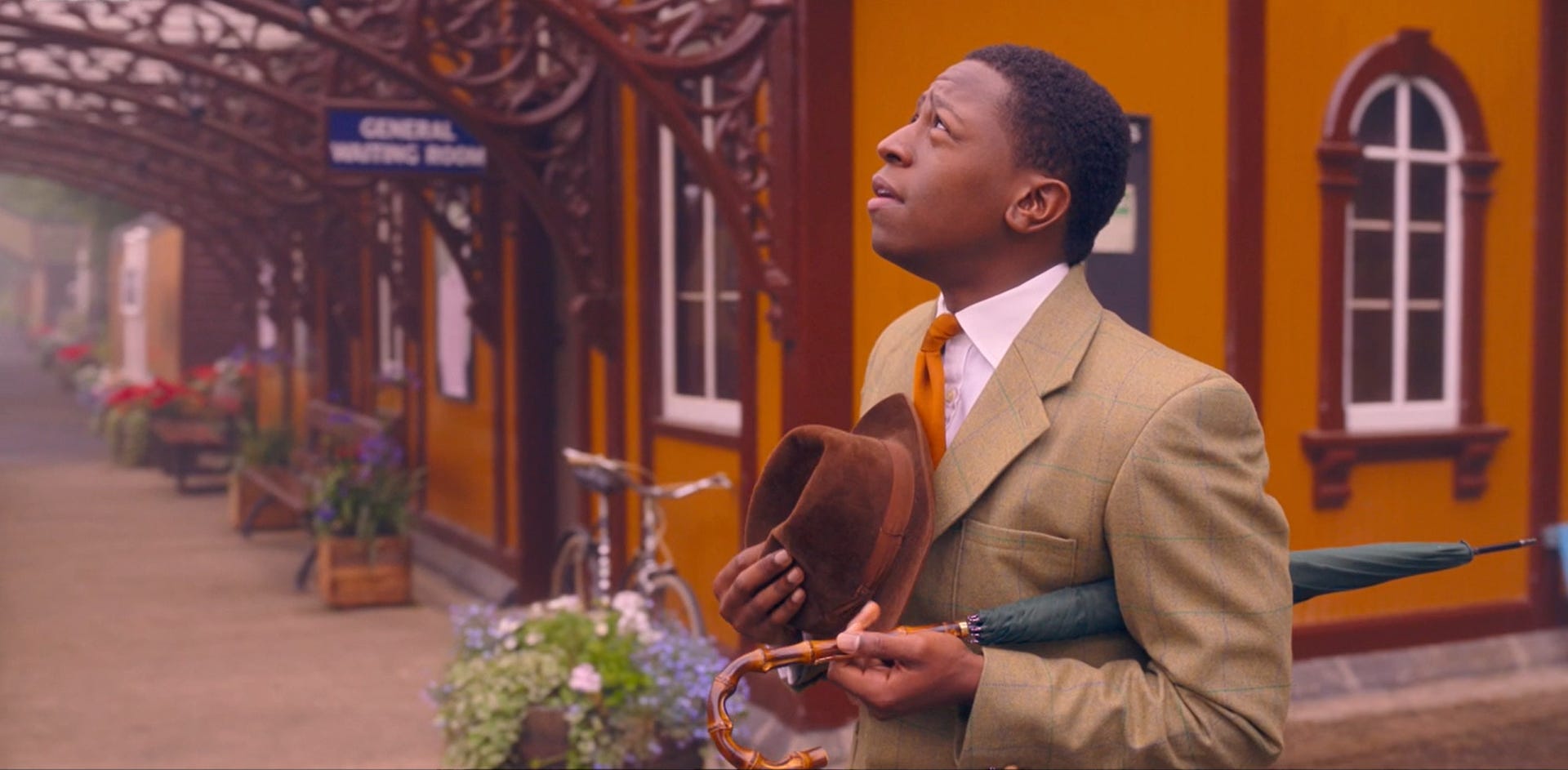
I RECENTLY WATCHED In the Land of Saints and Sinners, a shoot-em-up type of film starring Liam Neeson and set amid the Troubles in 1970s Ireland. The movie was, as one might expect, replete with the cultural staples and fashions of that time and place: flared trousers, sideburns, cigarette smoke, pints of Guinness and, of course, gun-toting terrorists.
As the plot begins to unfold, Neeson’s character, a contract killer, can be seen travelling to a small coastal town in County Donegal, whereupon he enters a pub. Some sort of traditional Irish shindig is taking place and, as the camera pans round, the viewer sees a man playing the fiddle. Nothing unusual there, one might think.
Except that this musician is a black man.
After finishing his tune, the fiddler wanders over to the bar and begins chatting with Neeson’s character. He speaks with a strong African accent, and we learn that he hails from some war-torn country. The pair engage in a bit of small-talk, and the film promptly moves on.
It was, of course, a faintly ridiculous scene. This was 1970s small-town Donegal. If, in real life, a person had, in that place and at that time, entered a pub in which someone was playing traditional Irish music on a fiddle, it is almost certain that the performer would not have been a black man from Africa.
The scene immediately jarred with me, as, I suspect, it did with others who viewed it. The whole thing seemed forced. The African fiddler appeared to have no particular relevance to the plot. His presence in the production seemed ahistorical and incongruous. It would be a bit like watching a film set in a tribal village in 1970s Africa and seeing Paddy McGinty hammering away on the old djembe drums.
The segment had the feel of having been shoe-horned into the film for reasons entirely unrelated to the storyline. As though the producers were trying to impart some sort of message. Which, of course, they were. The message being that they, the producers, are imbued with ‘progressive’ values, that they are proud cheerleaders for multicultural ideology, that films featuring all-white casts are inherently baneful (even where they reflect historical truth), and that they are willing to compromise the integrity and credibility of their work for the purpose of making their ‘enlightened’ views known to their audience. I certainly struggle to see any other plausible explanation for the decision to write the scene into the script.
It isn’t only film-makers, of course, who are guilty of this kind of virtue signalling. The entire phenomenon plagues our creative and cultural sector - to the point where it has become impossible to ignore. Television entertainment (especially drama), advertising, museums, libraries, the arts, publishing, tourism: these are just some of the industries whose chiefs seem intent on portraying our country and its history in ways that are wildly inconsistent with reality, often by crudely over-representing minority communities and cultures while downplaying – or, worse, constantly besmirching – the role of the majority population and culture.
Some years ago, I read a few of the crime novels of author Stephen Booth. The stories were set around the Peak District and centred on the work of detective duo Ben Cooper and Diane Fry. They were recently adapted for television by Channel 5. Inexplicably, Detective Constable Fry, an ordinary white British female officer in the books, was portrayed by an actress of Indian Punjabi descent. I am not sure what the audience was supposed to make of this. Was this ‘colour-blind casting’ at work? Or was the character herself an Indian Punjabi who had somehow acquired a quintessentially English name? I didn’t bother watching the series and so have no idea if any explanation was forthcoming.
Similarly, a 2021 ITV adaptation of HE Bates’s The Darling Buds of May (titled The Larkins), set in 1950s rural Kent (about as ethnically and culturally homogenous a place as ever existed), was made to look as if it were located in contemporary Islington. Again, was this colour-blind casting in action? Or were the producers genuinely trying to convince us that this was how the Kent countryside looked seven decades ago?
‘Ah, but it’s fiction,’ some people will say, ‘and you can do anything you like with fiction’. Well, to a point. If, for example, a piece of work is intended to take you to a different world – something that falls within the genres of, say, fantasy or sci-fi – the producers may rightly take all sorts of liberties. But if the work is rooted in places and periods, or around events, that are – or were – real, and that actual living persons would ordinarily recognise and identify with, is there not some sort of duty to reflect these things, as well as one is able to, accurately? I think there is.
So when producers engage in deliberate distortion of this kind, they can hardly complain if their work is afforded less respect than would otherwise be the case. After all, the best productions are those that are plausible – those that, because of their believability, wholly capture the viewer or reader so that, for a short time, he is immersed in the world before him. As soon as I saw the African fiddler in In the Land of Saints and Sinners, I was wrenched from my absorption in the film and reminded that I was watching a work of total fiction – and not a very credible one at that.
I have, in fact, been making the case for some years now that, for many, this cultural and historical revisionism has become a relentless and tedious moral lecture. One need only speak to one’s fellow citizens in the pub or at work, or follow debates on social media, to comprehend the degree to which the phenomenon has had a corrosive and alienating effect, such that public faith in the bodies and institutions responsible for driving it has nosedived.
Needless to say, my stance has persuaded certain opponents to accuse me of, well, you can guess. Anyone who dares challenge the persistent and politically-motivated falsifying of reality in this way is liable to have all sorts of nonsense thrown at him by the sanctimonious wokerati.
So it was with a sense of vindication that I read recently that an independent review into BBC output had concluded that the corporation’s over-representation of ethnic minority characters in its drama productions – especially in period dramas – can feel ‘clunky’, ‘inauthentic’ and ‘preachy’ to the viewer. The review, which was commissioned by the Beeb itself, found that diversity (let’s call it hyper-diversity, for that is what it is) can often seem ‘superimposed, rather than arising out of the subject matter’. This, suggest the authors, may leave viewers feeling as though they are ‘being lectured’.
The review cites a 2023 BBC adaptation of Agatha Christie’s Murder is Easy, which, though a traditional murder mystery set in an English village, bizarrely incorporated themes of anti-colonialism and West African Yoruba culture. It also questions the authenticity of the casting choices for the police drama Shetland, which has featured a string of characters of ethnic minority heritage – from countries as far afield as Tanzania, Sri Lanka and Jamaica – even though in real life the ethnic minority population of the Shetland islands, which lie between the Scottish mainland and Norway, stands at just 1%.
The review also finds that there is a perception among viewers that the BBC ‘can still be London-centric and skewed towards the middle class’, and that ‘the London-based perspective can cause programme-makers and commissioners to assume that the rest of the UK is close to London’s demographics’.
Speaking of the corporation’s executives who commission programmes, one stakeholder told the authors, rather fascinatingly, ‘Every single one of them lives within 15 miles of each other. They go to the same restaurants, and they read the same books. They go to the same plays, and they have the same friends.’
Perhaps the most instructive passage of the review was this one: ‘What needs to be avoided is ethnic diversity which looks forced and tick box, and we found our interviewees of colour as emphatic on this point as those who were white.’ In other words, the hyper-diversity zealots do not even enjoy the support of ethnic minorities in their crusade. So on behalf of whom are they are actually crusading? Only themselves, it would seem.
Maybe, just maybe, the tide is beginning to turn on these hucksters. If that proves to be the case, it won’t be a moment too soon.
A reminder that you can follow me on ‘X’: @PaulEmbery
I’ve seen that Liam Neeson film. It was a shocker, even without the cringy addition of the black fiddle player.
I think the question about these performative gestures and ‘interventions’ is this: who is making them and for what audience?
In my opinion the answer in both cases is that it’s overwhelmingly white middle class creative class liberals. The attempt to force black characters into these type of dramas is a symbol, a code, a call out to fellow white middle class liberals.
It’s certainly not done by or for actual black people who are as bemused as the rest of us. It’s doing nothing to build solidarity (and nor is it intended to) and it’s doing nothing to deepen or widen historical contexts or understanding.
I hope that it is dying out as Paul suggests, but the mind virus that produces these risible people remains virulent!
Great article Paul. Just waiting for the remake of John Wayne's films now........