

You probably won’t agree with all of Mr Embery’s policy prescriptions, but he will force you to think outside your usual political grooves — Wall Street Journal
SOMETIMES it’s hard to avoid the conclusion that Britain’s political elites are engaged in some sort of private game to see just how far they can test the patience of the native population before it snaps.
A people who were, and still are, remarkably tolerant in all sorts of ways, including towards those from minority backgrounds and cultures, seem daily to have their good faith exploited.
Only someone who had been living under a rock for the past couple of decades could have failed to notice the gulf that has emerged between our political institutions and everyday folk living outside of our fashionable cities and university towns.
That gulf – which is widening still – explains why a palpable sense of polarisation exists across many parts of the country today.
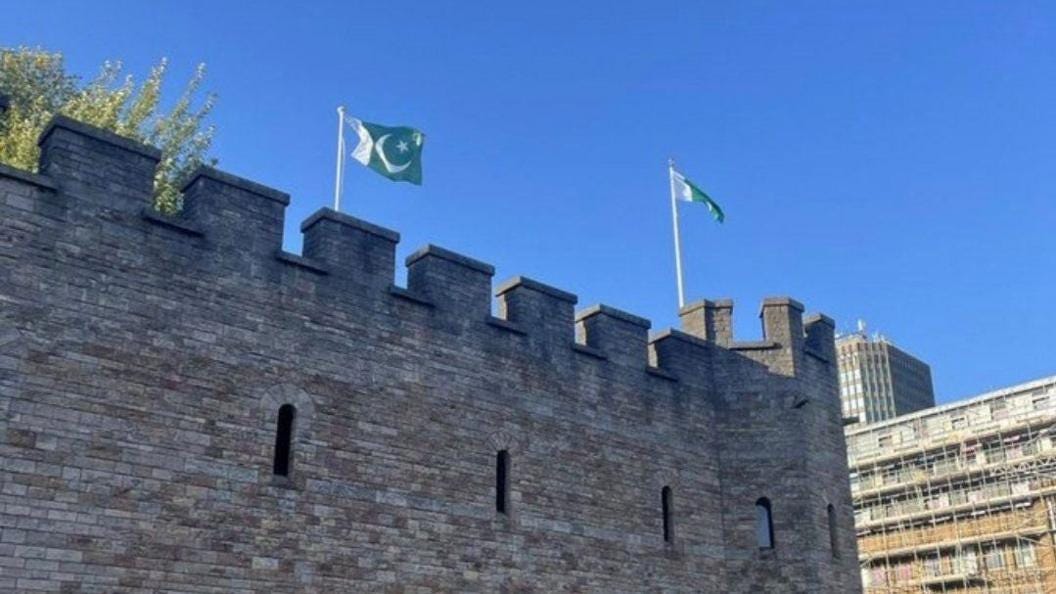
The latest attempt to stir the pot comes courtesy of Cardiff council, which recently decided to fly the flag of Pakistan from the city’s castle – one of the Welsh nation’s most historic and iconic sites. The flag was apparently hoisted in celebration of Pakistan’s independence day and stayed there over two days (a similar thing happened in 2024 - see image).
Needless to say, a row swiftly broke out, with Reform voices locally and nationally attacking the decision and in return facing accusations from their political opponents – who seemed to close ranks around the issue very tightly – that they were seeking to incite hatred and division.
Recent history tells us that anyone who expresses even mild disapproval about this type of virtuous ingratiation of foreign nationalities and cultures by our public bodies is likely to face taunts of being some kind of embittered xenophobe or reactionary. And, usually, the condemnation will be accompanied by a lecture trumpeting the merits of living in a diverse and multicultural society.
But those who harbour misgivings surely have a point. Because such acts do rank as a kind of provocation. It’s one thing seeking to foster good relations with other nations and cultures – such an approach is eminently sensible – but it’s another thing entirely indulging those nations and cultures to such a degree that many indigenous citizens begin to feel their own country is losing its historical identity and turning into something resembling a supersized version of the Olympic village. And that is where many Britons feel their country is now.
That Pakistan is a member of the Commonwealth did not appear to be the prompt for Cardiff Council’s decision, for no councillor seems to have cited that justification in defence of it. Moreover, the colours of non-Commonwealth nations, such as Poland, have also been displayed over the castle in recent times.
‘Oh, it’s only a flag, and it’s just for two days,’ the citizens-of-nowhere will argue. Except that it isn’t only a flag, and it isn’t just two days. What we have seen over the past couple of decades is a subtle but concerted effort on the part of Britain’s elite class to embed the ideology of cosmopolitan universalism across all areas of our public life.
These people are globalists in every sense. They see our country as a shop, not a home.
They believe in permissive migration policies, free trade libertarianism and technocratic supranationalism – all things to which large chunks of the population are hostile.
They dislike the concept of the nation state – except, of course, in the case of ‘oppressed’ nations – and believe Britain must forever go on atoning for its past ‘sins’.
They sneer at the majority culture of these islands – insinuating repeatedly that it is valueless because nothing is truly British – while promoting with great enthusiasm minority cultures and chivvying the rest of us to do the same. Asymmetric multiculturalism, as it is known.
They wanted to shape the entire nation in their image and, having such influence, grew accustomed to everything going their way. But eventually it became obvious that their philosophy was causing significant damage to the social fabric and, against the backdrop of major demographic change, had created a sense among sizeable sections of the majority culture that they were losing their status in society.
When the economy is performing well, ruling elites may face less resistance in their attempts to impose large-scale cultural transformation. But when it isn’t, those who are feeling the pinch are more likely to hunker down and seek solace in the familiar – in the bonds of community, relationships, place, custom and tradition. That’s a truth that the political class in our country has, to the great cost of all of us, consistently failed to understand.
Take my old home borough of Barking and Dagenham in east London. The place has, since the turn of the century, been wracked by a sense of discord and dislocation caused by the impact of mass immigration. Among the thousands of new arrivals into the borough were large numbers of Albanians, several of whom were involved with organised criminal networks. The gangsters took over a local housing estate and caused widespread misery among local residents. Their villainous activities reached the pages of national newspapers.
So what did the local council see fit to do? Why, it held a high-profile celebratory event to mark Albania’s independence day and hoisted that country’s national flag above the town hall.
How were the many local citizens who had suffered at the hands of the gangsters supposed to react to this spectacle? Were they meant to cheer it on as a testament to the borough’s wonderful diversity and inclusiveness? To set aside the harmful impact of Albanian immigration on their own lives and their community’s wellbeing?
The council’s actions were nothing less than a form of trolling. They showed no understanding of the unease that might be felt by the borough’s long-term residents at the seismic – and often detrimental – changes occurring in their neighbourhoods.
I’m happy to be convinced otherwise, but I cannot imagine that it is commonplace for the English or British flags to be flown on Albania’s public buildings or historic sites, nor the Welsh flag on Pakistan’s. And I’m not sure that, outside of visits by state dignitaries and other special bilateral occasions, such a practice is especially routine between other countries around the world. It seems that Britain’s political class has a particular predilection for this type of cultural virtue-signalling.
I am also compelled to ask, in respect of the Cardiff affair, why it is that the flag of a foreign nation flying over one of Britain’s ancient fortresses is not deemed threatening or intimidatory, but the display of our own national flags on lamp posts is.
History shows us that the most stable and successful countries tend to be those which, while willing to give space for minorities to follow their own traditions, are ultimately entirely confident about promoting their own overarching national culture above all others. Those that follow such an approach – Japan, for example – are often among the most civilised and free of nations. Whereas those who go down the pick ‘n’ mix, something-and-nothing, ‘all cultures are equal’ route invariably end up with lower levels of social trust and solidarity. And, as a consequence, their governments are required to resort to ever more authoritarian and tone-deaf measures to hold it all together.
It isn’t too late for Britain’s ruling elites to realise they have taken a seriously wrong turn on these issues. But I fear that very soon it will be.
A reminder that you also can follow me on ‘X’: @PaulEmbery
An edited version of the above piece first appeared on the GB News website.
Hi Paul 👋
The thing with flags is that councils will pay to put up lgbtq+ , Albania, Pakistan, Ukraine etc but then complain and pay to have the English flag removed.
Personally I would appreciate if councils would spend time on things like cleaning the streets, repairing roads and emptying the bins , but I guess thats to much to ask these days ...
Have a lovely week Paul and other readers 😀
Your sincerely ",unfriendly from Dagenham " 😉
So damn true Paul, well said - and keep saying it!